A discipline for governed knowledge

Know what you know. And prove it.

In the age of AI, the signals we used to trust — where a claim came from, who stands behind it, whether it still holds — are disappearing. Knowledge Foundry is a discipline for governing knowledge so that what people, institutions and machines reason from stays traceable, accountable and sound.

The problem

More information. Less trust.

Generative AI produces fluent, plausible content instantly — and strips away the provenance and authorship that once told us what to believe.

For thirty years we made our documents, processes and data legible to machines. The layer that actually carries our knowledge — judgement, evidence, the difference between a correct answer and a defensible one — was never built to be governed. A system is only as sound as the knowledge beneath it, and ungoverned knowledge does not scale; it multiplies error, confidently.

The gap is not the machine's ability to answer. It is our inability to say where an answer came from, why it should be believed, and who is accountable for it. That is a gap in governance, not technology.

The idea

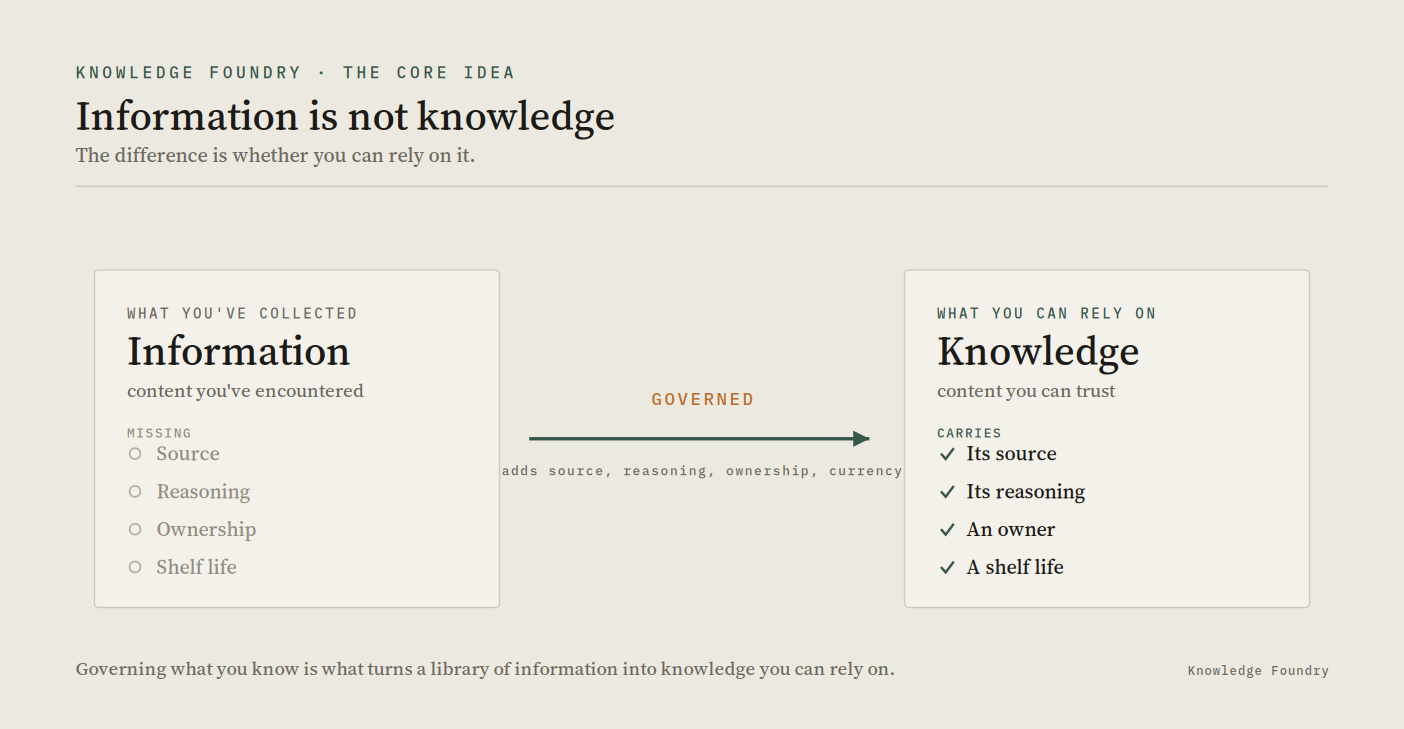
Information is not knowledge.

Knowledge worth relying on has been examined, justified and accepted by someone accountable — and it changes under control.

Knowledge Foundry treats it as a governed object with a life: an origin, evidence, a reasoned justification, an authority who accepts it, and a recorded history of change. Rigour matches the stakes — a working note is held lightly; a board decision is held to account. And it is honest by design: counter-evidence stays attached, and a claim's standing is stated plainly.

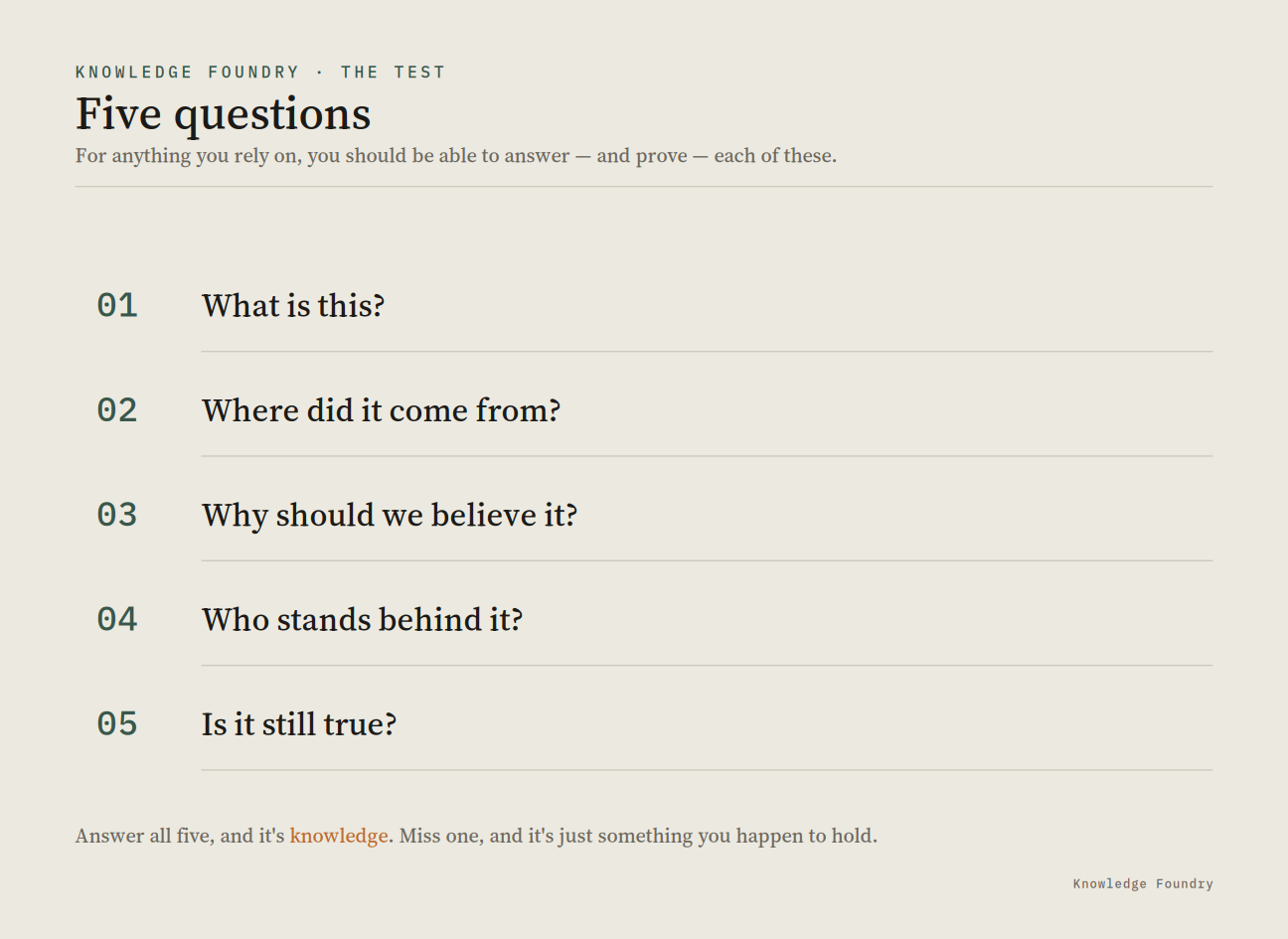
01What is this?
02Where did it come from?
03Why should we believe it?
04Who authorised relying on it?
05What has replaced it?

Why believe it

Rigour you can inspect.

Grounded

Derived from evidence

Built from mature traditions — knowledge engineering, knowledge management, records governance, AI. Not invented from scratch.

Complete

A full reference architecture

Set out end to end, from the principles that never change to the tests that prove an implementation honours them.

Concrete

A worked example

One ordinary decision, governed from first question to final call — in plain English any professional understands.

Neutral

Domain-independent

The same discipline governs an HR policy, a clinical note, a research finding or a strategy. The subject changes; the architecture does not.

Who it is for

Built for anyone who holds knowledge to account.

For professional associations

A credible, non-vendor account of how your members create, validate and rely on knowledge — now that AI is in every workflow. Ready to shape into guidance, CPD and conference material the whole profession can adopt.

A standard for how your profession knows →

For educational institutions

A rigorous, teachable account of how a claim earns the right to be relied upon — directly relevant to academic integrity and research provenance in the age of AI. Ready as a module, a framework, or a research collaboration.

How knowledge becomes trustworthy →

For self-directed learners

The discipline works at the scale of one: turn what you read into knowledge you can trust — and keep it. Free to read, nothing to buy.

A discipline for your own knowledge →

A worked example

Should we move to a four-day week?

Watch a good decision get made — from first question to final call, and back again when the evidence changes.

The question is posed and the evidence gathered — real trials, real counter-evidence. Each source is weighed. A reasoned case is written, its assumptions stated and its limits admitted: warranted for a trial, not yet for permanent adoption. An authority accepts it for a defined use; it informs the decision, is monitored, is revised when the trial reports, and is eventually folded into a broader policy. Nothing is erased — the whole history can be reconstructed. Swap the subject for a clinical guideline or a research finding and every step is the same. That is the point.

The stance

We do not make more information. We make knowledge you can trust.

A discipline and reference architecture, in the hands of professional associations and educational institutions — and, in time, the foundation for governed implementations, built profession by profession.

Read

The work, in full and in brief.

Everything is open. Read the short version to understand the idea, or the complete reference architecture to see it entire.
The Reference Architecture — complete manuscriptPDF · Word
The Overview — the whole programme on a pagePDF
The Worked Example — one governed decisionRead
Essays · “What do you actually know?”Read essay 1 →

The problem

AI can write anything. That is exactly the problem.

For thirty years we made our documents, processes and data legible to machines. That work is nearly done. The layer that actually carries our knowledge — judgement, evidence, the difference between a correct answer and a defensible one — was never built to be governed.

What changed

Generative AI made that layer computable overnight. It can now structure and reason over an organisation's knowledge at a scale never possible before. But a system is only as sound as the knowledge beneath it, and ungoverned knowledge does not scale — it multiplies error, confidently.

The real gap

The gap is not the machine's ability to answer. It is our inability to say where an answer came from, why it should be believed, and who is accountable for it. That is a gap in governance, not technology — and it is the one Knowledge Foundry closes.

The question is no longer whether a system can produce an answer. It is whether you can stand behind the one it gives.

Next — the idea

The idea

Treat knowledge as a governed object, not a file.

The distinction the whole discipline turns on is simple: information is content; knowledge is content that has been examined, justified and accepted by someone accountable, and that changes under control.

Information is not knowledge: governance adds source, reasoning, ownership and a shelf life.

A life, not a document

A governed knowledge object carries its origin, the evidence and reasoning behind it, the authority who accepted it, and its history as it is revised or retired. It can be inspected, questioned and trusted — because every step is on the record.

Proportionate, not bureaucratic

Rigour matches the stakes. A working note is held lightly; a board decision is held to account. The same discipline covers both; only the depth changes.

Honest by design

Governed knowledge makes uncertainty visible rather than hiding it. Counter-evidence stays attached; a claim's standing is stated plainly. Trust is earned by being sound, not by being loud.

The five questions: what is this, where did it come from, why believe it, who stands behind it, is it still true?

This is not a tool you buy. It is a discipline you adopt — set out in full as a reference architecture, and free to read.

The architectureRead & download

The reference architecture

The whole discipline, set out to be inspected.

Knowledge Foundry is published as a complete reference architecture — from the principles that never change to the tests that prove an implementation honours them. It is technology-neutral: it says what must be true, not which software must be used.

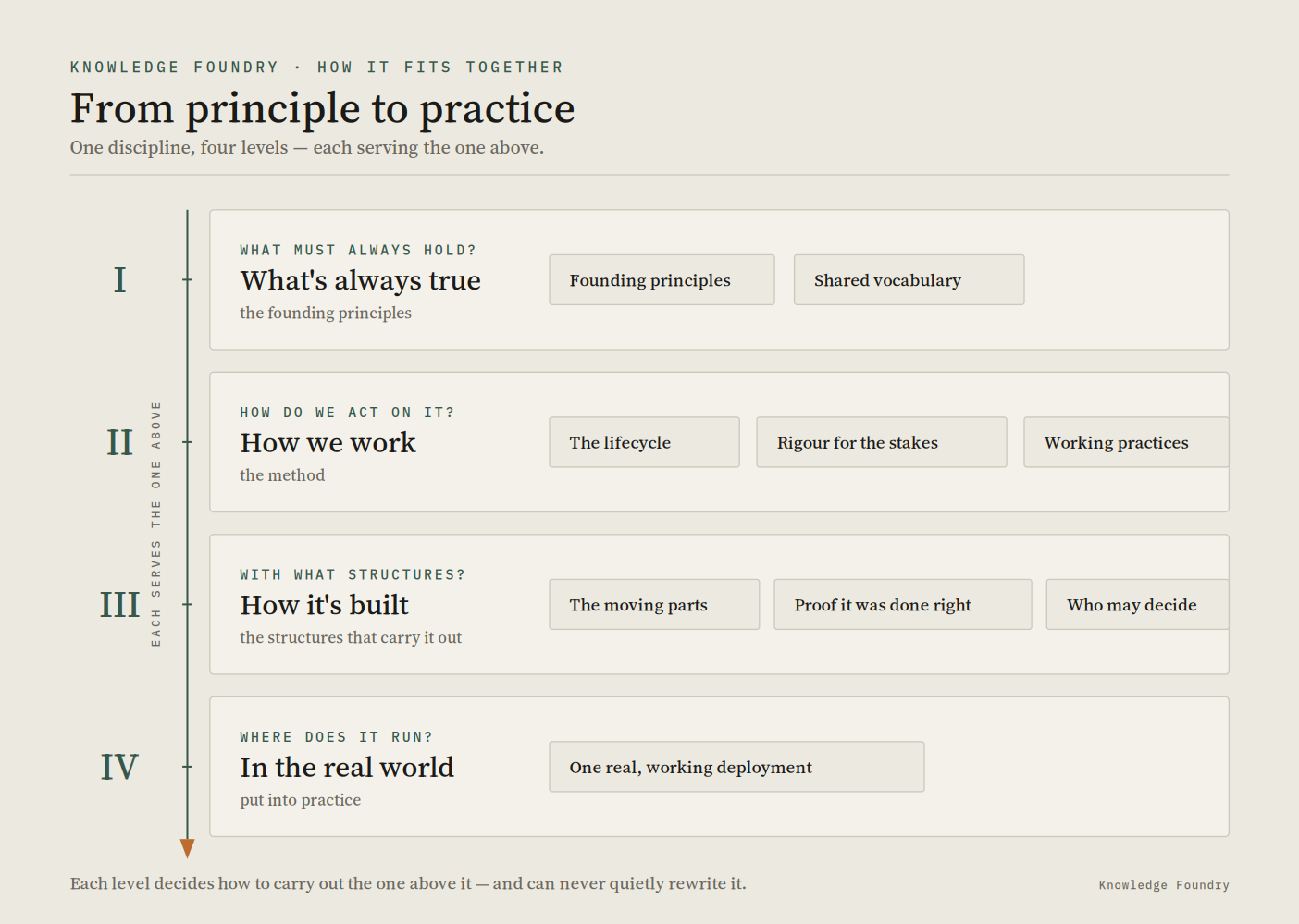
From principle to practice: four levels, each serving the one above.

Four levels

A lower level chooses how to satisfy a higher one; it may never quietly revise it.

01Principlewhat is always true
02Methodhow we act on it
03Architecturewith what structures
04Implementationin a specific deployment

What it covers

The lifecycle of a knowledge object from capture to retirement; how much rigour a decision deserves; who may make a decision consequential; and how any of it can be reconstructed and shown to conform.

The full architecture is available to read and download.

Read & download

A worked example

Should we move to a four-day week? Watch a good decision get made.

To show the discipline without jargon, we follow one ordinary decision from first question to final call — and back again when the evidence changes.

01

The question is posed and the evidence gathered — real trials, real counter-evidence. Each source is weighed.

02

A reasoned case is written, with its assumptions stated and its limits admitted: warranted for a trial, not yet for permanent adoption.

03

An authority — the executive team — accepts it for a defined use.

04

It informs the decision, is monitored, is revised when the trial reports, and is eventually folded into a broader policy.

05

Nothing is erased; the whole history can be reconstructed.

Nothing here depended on working hours. Swap the subject — a clinical guideline, a research finding, a strategy — and every step is the same. That is the point.

For professional associations

A standard for how your profession knows.

Your members create, validate and rely on knowledge every day — and AI is now in every one of those workflows. Knowledge Foundry gives you a credible, non-vendor account of how professional knowledge should be governed, ready to shape into guidance your members can adopt.

Adoptable

Adoptable guidance

A framework your members can put to work, not a product to buy.

Ready

CPD and events

Material for webinars, conference sessions and continuing development.

Independent

Credibility

A rigorous, independent foundation your association can put its name to.

How we could work together

A member webinar or conference session
A co-developed guidance note or practice framework
A working group
A contribution to a standard
Start a conversation

For educational institutions

How knowledge becomes trustworthy — teachable, and rigorous.

Academic integrity and research provenance are under new pressure in the age of AI. Knowledge Foundry offers a disciplined, teachable account of how a claim earns the right to be relied upon — directly relevant to how your institution teaches, researches and governs its own knowledge.

Teachable

Teaching material

A ready module on how knowledge becomes trustworthy, for any discipline.

Governance

Integrity and provenance

A framework for research governance and academic integrity in the AI age.

Open

A research programme to align with

An open, citable body of work.

How we could work together

A guest lecture or seminar
A curriculum module
A departmental pilot
A research collaboration
Start a conversation

For self-directed learners

A discipline for your own knowledge.

You consume more than ever — books, papers, threads, and now answers from AI about anything. But can you say what you actually know: where it came from, why you believe it, and whether it still holds? The discipline works at the scale of one. Apply it to your own learning and your notes stop being a pile of information and become knowledge you can reason from — and trust.

Clarity

Know what you know

Separate the information you've collected from the knowledge you can rely on — and make your confidence, and your uncertainty, explicit.

Provenance

Keep the why

Hold on to where a claim came from and why you believed it, so a note written a year ago still means something — to you, or to a machine you hand it to.

Under control

Learn without overwriting

Update what you know as you learn more, without silently erasing your past reasoning. Light for a passing note; rigorous for a belief you will act on.

Where to start

The worked example — one decision, governed end to end. The same moves apply to your own learning.
The overview — the whole discipline on a page.
The essays — short pieces that teach it one idea at a time. Coming soon.
Read the work Start with the idea

Read

The work, in full and in brief.

Everything is open. Read the short version to understand the idea, or the complete reference architecture to see it entire.
The Reference Architecture

The complete programme manuscript.

PDF · Word
The Overview

The whole programme on a page.

PDF
The Worked Example

One governed decision, end to end.

Read
What do you actually know?

Essay 1 · the core idea

Read →
Being right isn't enough

Essay 2 · being right vs being trusted

Read →
Knowledge has a shelf life

Essay 3 · why knowledge must change

Read →

Citable, versioned, and free to read.

← Read & download

Essay 01

What do you actually know?

You've read a thousand things. Almost none of them are knowledge yet — and in the age of AI, that difference is the whole game.


Think of something you're sure you know. Not a fact you'd look up — something you'd act on. That a certain way of eating works. That your field is moving in a particular direction. That an investment is sound, or a study you read last year proved a thing.

Now try to reconstruct it. Where did it come from? What was the actual evidence, as opposed to the headline? What would have to be true for it to be wrong — and do you know whether it is? When did you last check?

For most of what we carry around, the honest answer is: I can't say. We have a library in our heads we can't cite.

This isn't a memory problem, and it isn't a matter of trying harder. It's a category problem. We treat information — the things we've read, watched, highlighted, half-remembered — as though it were knowledge. It isn't, not yet. And the difference has never mattered more, because we now have machines that produce fluent, confident, sourceless information about anything, on demand. The pile keeps growing, and the ground under it keeps getting softer.

Information is not knowledge

Information is content you've encountered. Knowledge is content you've examined — that you can stand behind, that carries its reasons with it, and that you can change without losing the thread. The gap between the two is work, and it's the work almost no one does on their own reading.

Here's the test. For anything you rely on, can you actually answer — not gesture at:

- What is this, exactly? The claim, not the vibe of it. - Where did it come from? The source, and how good the source was. - Why do I believe it? The reason — including the best case against it. - How sure am I? Certain, leaning, or just repeating something? - Is it still true? What's changed since I decided this?

If you can answer those, the thing is knowledge. If you can't, it's a rumour you happen to hold. Most of what any of us "knows" is the second kind — and we find out the hard way, when we repeat it and get challenged, or act on it and it fails.

Governing your own knowledge

The good news is that turning information into knowledge doesn't take more reading. It takes a few small habits — the same discipline serious institutions use to govern what they know, applied at the scale of one.

Keep the source with the claim. A claim without its origin isn't knowledge; it's a floating sentence. When you note something worth keeping, capture where it came from and how strong that source was in the same breath. Your future self can't reconstruct a provenance you never wrote down.

Write the reason, not just the conclusion. The thing worth keeping isn't "four-day weeks improve productivity." It's why you believe that, and what would change your mind — the best evidence and the best counter-evidence, side by side. A belief with its reasoning attached can be defended, questioned, and updated. A bare conclusion can only be asserted.

Mark how sure you are. There's a world of difference between "I know this," "I think this," and "I'm relying on this without having checked." Say which. Making your own uncertainty visible isn't weakness — it's the thing that tells you where to look next. Most bad decisions are things we were sure of for no recorded reason.

Update without overwriting. When you learn something that changes a belief, don't quietly swap the old version and pretend you always thought so. Note what changed and why. The trail matters — partly because you'll want it later, and partly because a belief that has survived a recorded revision is worth far more than one that has never been tested.

And don't do this for everything. This is the part people miss. A passing curiosity needs none of it. A claim you're going to act on, teach, or repeat in public earns all of it. Spend the effort where the stakes are; the discipline isn't rigour for its own sake, it's rigour matched to what you're going to rely on.

None of this is a system to buy or an app to install. It's a way of holding what you learn. You can do it in a notebook.

Why now

You could have ignored all of this ten years ago and mostly gotten away with it. Reading was slow, sources were visible, and the friction of finding things did some of the filtering for you.

That friction is gone. A model will now produce a confident, well-written, entirely sourceless answer to any question you ask, in seconds — whether or not it's true, whether or not anyone stands behind it, whether or not it was true yesterday. The fluency is total; the provenance is zero. That is a genuinely new situation, and it's precisely the one these habits were built for.

If you can't govern your own knowledge, you won't be able to tell your understanding apart from a plausible paragraph a machine generated for you. From the inside, they feel the same. The only defence is to know — for the things that matter — what you actually know: where it came from, why you believe it, and whether it still holds.

The point

The goal was never to know more. Knowing more is easy; it's just consumption, and we're drowning in it. The goal is to know what you know — to be able to stand behind it, to yourself first. That isn't a productivity trick. It's a quieter, older thing: the difference between having read about something and actually understanding it, made deliberate.

You've read a thousand things. Pick the handful you're going to rely on, and make them knowledge.

This is one idea from Knowledge Foundry, a discipline for governing knowledge in the age of AI. The same five questions scale from a single learner to an entire institution — the subject changes; the discipline doesn't.

Next · Being right isn't enough →
← Read & download

Essay 02

Being right isn't enough

A good argument and a claim someone will stand behind are two different things — and in the age of AI, the gap between them is where the risk now lives.


You have probably written the memo. The analysis was sound: the evidence was there, the reasoning held, you'd even handled the obvious objections. You sent it. And then nothing moved. Six months later the organisation did roughly the opposite, and if you asked why, no one could quite say. You were right, and it changed nothing.

Now the other version, which is worse. Everyone was relying on a number — in the forecast, the model, the board pack. It had been there for years. Then it turned out to be wrong, and as the damage was counted, a strange thing surfaced: there was no one to hold responsible. Not because people were hiding, but because no one had ever actually decided to rely on it. It had simply accumulated. Everybody trusted it because everybody else did.

These two failures look like opposites — one where a good claim goes nowhere, one where a bad claim goes everywhere. They have the same root. Both confuse two things a serious organisation has to keep apart: whether a claim is justified, and whether anyone has accepted it.

Two different acts

Justification is the case for a claim: the evidence, the reasoning, the counter-argument met. It lives entirely inside the claim. A thing is justified or it isn't, regardless of who is looking at it.

Acceptance is a different act altogether. It is a person — or a body — with the authority to do so deciding that we will rely on this, and taking responsibility for that reliance, within a stated scope. Acceptance isn't about whether the claim is good. It's about whether anyone is willing to stand behind acting on it.

You can have either without the other, and once you notice the distinction, you see both gaps everywhere.

Justified, but never accepted

The correct memo that changes nothing is a claim that was justified but never accepted. This is the quiet grief of every capable person in a large organisation: the belief that being right ought to be enough. It isn't, and it was never going to be. Being right earns a claim the right to be relied upon. It does not cause the reliance. Somebody accountable has to take the second step — to say, in effect, "yes, we are going to act on this, and I will own that we did." Without that step, the best analysis in the building is a very good document and nothing more.

If you have ever been that person, the lesson is not "argue harder." It is that your correct thing needs an owner, not just an audience.

Relied upon, but never accepted

The number everyone trusted and no one owned is the mirror image: reliance without acceptance. This one is more dangerous, because it fails silently and leaves no one accountable. Reliance tends to accrete by default — a figure gets used once, then cited, then built on, until an entire structure rests on something nobody ever signed off. There was no moment when a named person said "I accept that we depend on this." So when it breaks, there is no owner, because ownership was never taken.

Organisations walk into their worst failures this way — not through a bad decision, but through the absence of a decision everyone assumed someone else had made.

Acceptance is a real act, not a rubber stamp

This is why acceptance, done properly, is specific and accountable: someone with the authority, taking responsibility, for a defined scope of reliance — we will rely on this for this, and not for that — at a moment you could point to afterwards. It is the point where a claim stops being an argument and becomes something the institution stands behind.

A profession's standard of practice, a board's sign-off, a regulator's approval, an editor's decision to publish — at their best these are all the same move: turning a justified claim into an accepted one, and putting a name to the reliance. Strip the name away and you don't have a faster process; you have an accountability vacuum with good production values.

Why this matters more now

Justification has become cheap. A model will generate a fluent, well-structured, superficially rigorous case for almost any claim you like in seconds — and an equally fluent case against it. Arguments are no longer scarce. The appearance of justification is now essentially free.

Which means the load-bearing act is no longer producing a good argument. It is acceptance — a named, accountable person or body deciding to rely on something, within a scope, and owning that reliance. When the machine can justify anything, "is there a good case for this?" stops being a useful filter, because there is always a good case for everything. The only question left with any weight is the old one: who is accountable for us relying on this?

We are entering a period where justification is abundant and acceptance is scarce. Scarce things are where both the value and the risk concentrate.

From one mind to many

At the scale of one, you already do a version of this. The difference between "I have convinced myself this is right" and "I am going to act on this" is exactly the difference between justifying a claim and accepting it — and knowing which you are doing is half of thinking clearly.

At the scale of a team, a profession, or an institution, the same distinction has to be made deliberate and visible, because the reliance is shared and the consequences land on people who were never in the room. That is what standards bodies, review boards, and sign-off processes are for. It is also, not coincidentally, exactly what erodes first when everyone is moving fast and the machine is producing confident answers on demand.

The point

Being right is necessary. It has never been sufficient. The claims a profession actually runs on — the ones that hold up when they are challenged, and have someone to answer for them when they don't — are the ones somebody was willing to stand behind. In an age when anything can be argued, the argument is the cheap part. The signature is the scarce one.

This is one idea from Knowledge Foundry, a discipline for governing knowledge in the age of AI. It draws a hard line between justifying a claim and accepting it for reliance — because the institutions we trust are built on the second, not the first.

Next · Knowledge has a shelf life →
← Read & download

Essay 03

Knowledge has a shelf life

Everything you know was true as of some date you probably can't name. Keeping knowledge trustworthy was never about getting it right once — it's about how you let it change.


Somewhere in your organisation there is a number that was correct in 2019 and has been quietly wrong ever since. A policy written for a world that no longer exists. A rule of thumb everyone still repeats, from a study that has since been overturned. No one is being careless. The claim was right when it was made; it simply expired, and no one was watching the date.

Now look inward. The advice you give, the assumptions you run on, the things you're confident about in your own field — when did you last actually check any of them? Most of what any of us knows was true as of some moment we can't name, and we have no idea which of our beliefs have quietly gone off.

This is the uncomfortable fact underneath everything: knowledge decays. Not because anyone changed the claim, but because the world moved and the claim didn't. A statement that was well-evidenced and true can rot into a confident falsehood without a single word of it changing — because what changed was outside it. Being right, it turns out, is not a possession you get to keep. It's a reading taken at a particular time.

The obvious fix, and the trap inside it

The obvious response is: update more. Keep everything current. That instinct is right — and it walks straight into a second, subtler failure that quietly does more damage than staleness ever could.

Call it the silent overwrite. Knowledge gets updated, but with no record that it changed. The document now says X. Last year it said Y. Nobody can tell, nobody can say when it flipped, and nobody can reconstruct why. You have kept your knowledge current and, in the same motion, destroyed your memory of it.

This sounds minor. It is not. An organisation that overwrites its knowledge in place loses three things it cannot function without.

It cannot audit its own past decisions, because it can no longer see what it knew at the time. Was that call wrong when it was made, or simply overtaken by events? Those are completely different verdicts, and you cannot tell them apart once the earlier version is gone.

It cannot learn, because learning means seeing your own trajectory — and it has erased the trajectory, keeping only the latest frame.

And it cannot answer the simplest challenge — why do we do it this way? — with anything better than "no one remembers." The reasoning was overwritten along with the conclusion.

Change under control

So the failure is not change. Change is not the enemy; ungoverned change is. Knowledge that stays trustworthy neither stands still nor gets rewritten in the dark. It evolves under control — which turns out to mean a few specific things.

You update deliberately, not by accident. You record what changed, and why. You preserve the old version rather than deleting it — it is superseded, not erased, so the trail survives. And a changed claim has to re-earn the trust the old one held; last year's version being accepted does not mean this year's inherits that standing automatically. (That's the thread from the previous essay: a new version has to be accepted again, by someone accountable — justification doesn't carry over just because the file name did.)

There is one more piece, quiet but decisive: currency. A claim worth relying on should carry not only is this true but when was this last checked, and what would trigger a review. A belief with an expiry condition attached is one that can tell you when to stop trusting it. Almost nothing we carry has one — which is exactly why so much of it goes off without our noticing.

Why the trail is the whole point

Notice what the trail actually buys you. Kept properly, it lets you tell "we were wrong" apart from "the world changed" — two sentences that pose as excuses for each other and are in fact opposite lessons. One means fix your reasoning; the other means update your inputs. You can only distinguish them if you kept the record of what you believed, when, and on what basis.

An institution that can see how its knowledge changed over time has a memory, and can improve. One that only ever sees the current version has a present, and quietly repeats itself.

Why this matters more now

All of this used to be a slow problem. It isn't anymore. The substrate under our knowledge is now being rewritten continuously and silently, at a scale we have never had to manage. Ask a model the same question twice and you may get two different answers, with no note of what moved between them. The answer that was authoritative in one session is gone in the next — no changelog, no superseded version, no trace. It is ungoverned evolution as a default setting.

Build on that, and you inherit claims with no shelf life and no lineage: no way to tell current from stale, no way to reconstruct why the ground shifted under a decision you made last month. The faster knowledge is regenerated, the more it matters that some of it is held under control — dated, tracked, able to account for its own changes. When the world's information keeps no memory, keeping yours is not bureaucracy. It is the advantage.

The point

Three things hold across these essays. Know what you actually know, and not merely what you've read. Know who is accountable for what you rely on. And know when it changed, and why. None of the three is a filing system. Together they are the difference between a mind — or an institution — that learns, and one that drifts, confidently, into being wrong.

The goal was never knowledge that never changes. That is just knowledge going quietly stale. The goal is knowledge that changes in the open — so that you can always say what you believe now, what you believed before, and what moved you between them.

This is one idea from Knowledge Foundry, a discipline for governing knowledge in the age of AI. It treats change as normal and silence as the danger: knowledge should evolve under control, keeping the trail that lets you tell growth from drift.

Back to Read & download

About

A discipline, derived from evidence.

Knowledge Foundry did not begin with a product. It began with a question — how does knowledge stay trustworthy as it moves between people, institutions and machines? — and a structured review of the traditions that have each answered part of it.

Where it comes from

The discipline is derived from a literature landscape spanning knowledge engineering, knowledge management, records and archival governance, and AI. Its principles are the obligations that evidence makes unavoidable.

Where it is going

Today, Knowledge Foundry is a discipline and reference architecture, in the hands of professional associations and educational institutions. In time, it is the foundation for Knowledge Operating Systems — governed implementations, built profession by profession.

Honest status

This is serious, in-progress work. The architecture is complete and internally consistent; parts of it await validation on a real institutional case before they are considered settled. We say “designed to,” not “guaranteed to.” The discipline is about warranted claims — so we hold our own to the same standard.

Get in touch

Start a conversation

If this is the work your institution is trying to do, write to us.

A webinar, a guidance note, a curriculum module, a pilot — the useful conversations begin with a specific problem rather than a demonstration.

Emailhello@knowledgefoundry.org
Enquiries fromAssociations · Institutions · Researchers

We answer every letter that names a real problem.